
Textile labels use a system of pictograms framed by an international standard, now referenced under code ISO 3758. This standard, led by Ginetex (International Association for Textile Care Labelling), establishes five families of symbols covering washing, bleaching, drying, ironing, and professional cleaning. The most recent version, ISO 3758:2023, has replaced the 2012 edition with several adjustments regarding the interpretation of maximum allowed treatments.
Update ISO 3758:2023: what changes for textile pictograms
Most online guides still refer to the 2012 version of the standard. However, the revision published in 2023 introduced clarifications that change the interpretation of certain symbols in daily use.
The hand wash pictogram has been specified to distinguish between hand washing at room temperature and hand washing at controlled temperature. This distinction, absent from the previous version, reduces the risk of damage to sensitive fibers like silk or certain fine wools.
Another notable point: the rules for professional wet cleaning have been further detailed. This process, which uses water under strict control of temperature and mechanical action, mainly concerns delicate textiles treated by dry cleaners or specialized circuits. Its more precise codification in the standard allows for a better understanding of washing machine detergent symbols when encountering a circle accompanied by the letter W on a label.
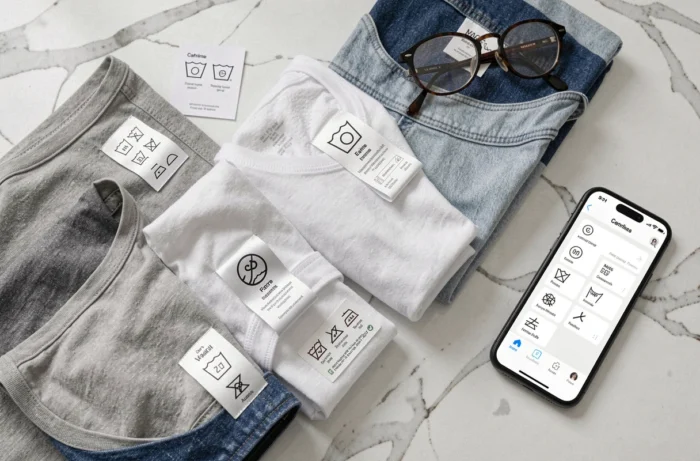
Washing machine symbols: reading the tub and its variants
The basic pictogram for washing is a stylized tub. The number inside indicates the maximum allowed temperature (30, 40, 60, or 95 degrees depending on the textiles). This number does not represent the ideal temperature but the threshold not to be exceeded to avoid irreversible damage.
The horizontal lines under the tub indicate the mechanical intensity of the cycle:
- No line: normal cycle, suitable for sturdy cotton or linen
- One line: moderate program, often called “synthetics” or “delicate” depending on the manufacturers
- Two lines: very gentle cycle, typically reserved for wool or fragile textiles, with reduced spin
A tub crossed with a cross means that machine washing is prohibited. A tub with a hand inside indicates exclusive manual washing.
The detergent compartments on the machine: I, II, and clover
The machine drawers generally have three compartments. The compartment marked with the Roman numeral II receives the detergent for the main cycle. Compartment I is for pre-wash, useful for very dirty laundry. The compartment identified by a pictogram in the shape of a clover (or flower depending on the brands) holds the fabric softener.
Confusing these compartments does not damage the machine, but the fabric softener poured into the wrong compartment will be rinsed too early, and the detergent placed in the clover compartment will only act during the final rinse, without any cleaning power.
Triangle, square, and iron: post-washing symbols
The triangle concerns bleaching. An empty triangle allows all bleaching agents. Two diagonal lines inside limit the use to oxygen bleaching only (sodium percarbonate, hydrogen peroxide), excluding chlorine. A crossed triangle prohibits any bleaching.
The square governs drying. A circle inside the square indicates that the tumble dryer is allowed. The number of dots in this circle specifies the heat level:
- One dot: low temperature drying
- Two dots: normal temperature drying
- Crossed square: tumble drying prohibited, prefer air drying
The iron works on the same principle of dots (one, two, or three) to indicate the maximum ironing temperature. A crossed iron means that ironing may damage the fiber or coating of the textile.

Digital textile product passport: towards the end of paper labels
The European regulatory framework is evolving beyond the pictograms sewn into garments. A Digital Product Passport has received its legal basis in 2024. Its principle: to associate each textile item with a unique identifier that provides access, via a QR code or NFC chip, to all care, composition, and traceability information.
For care symbols, this change could simplify reading. Instead of deciphering five tiny pictograms on a frayed label, the consumer would scan a code and obtain clear text instructions, updated if necessary.
Field feedback varies on this point: some textile professionals believe that the coexistence of physical labels and digital passports will create a period of confusion. Others consider that the digital passport will make physical symbols accessible even after the label has faded, a common issue with frequently washed laundry.
Textile care pictograms remain, for now, the only standardized language shared by all manufacturers and all countries. Knowing how to read a tub, a triangle, or a crossed square prevents costly mistakes on fragile items. The ISO 3758:2023 standard and the gradual introduction of the digital passport show that this system is not fixed, but the basic principle remains the same: each symbol sets a limit, not a recommendation.