
Positive education refers to an educational style based on kindness, firmness, and respect for the child’s development. It is based on research in developmental psychology, affective neuroscience, and attachment theory. Here are ten practical tips for applying it in daily life, going beyond the often-repeated big principles.
1. Reframe behavior as an unmet need

Marshall Rosenberg, the initiator of Nonviolent Communication, summarized the principle as follows: every criticism, every aggression expresses an unmet need. When a child screams or refuses to cooperate, the first step is to identify what lies behind the behavior (need for attention, rest, validation).
This reframing changes the parental stance. Instead of reacting to the symptom, we address the cause. A child who bangs on the table may be hungry after too long, or trying to catch the gaze of an adult absorbed in their phone.
As detailed in the positive education article on Mes Petits Pas, this framework reduces recurring conflicts because it addresses their origin rather than their manifestations.
2. Name emotions with precise vocabulary

Telling a child “you are angry” is not always enough. A precise emotional vocabulary (frustrated, disappointed, worried, upset) helps them distinguish what they feel and better regulate their reactions. Affective neuroscience shows that simply naming an emotion reduces the activation of the brain’s amygdala.
In practice, this involves short phrases: “You look frustrated because your drawing doesn’t look like what you wanted.” The child feels understood, and the tension decreases a notch.
3. Set a firm framework without resorting to punishment
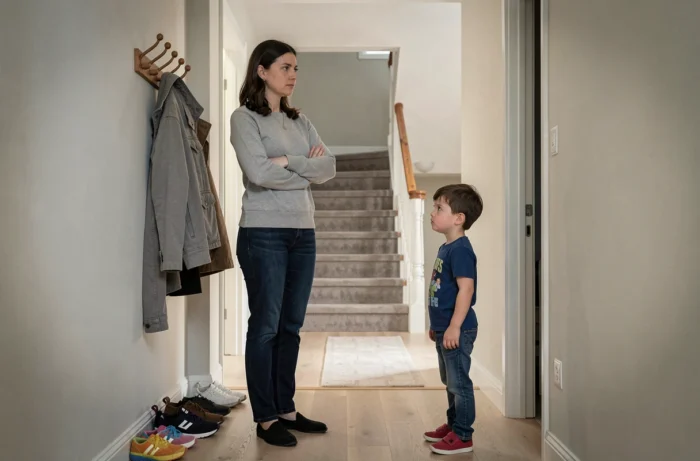
Positive education is not laxity. The educational framework remains structuring, but it is based on explained rules rather than arbitrary sanctions. A understood rule is more likely to be respected than a rule imposed under threat.
When the rule is broken, repair replaces punishment. A child who deliberately spills their drink cleans the table. The reparative act creates a logical link between the behavior and its consequence, which corner time does not.
4. Use a time-out instead of a hot reaction

Reacting in the heat of the moment often leads to words or actions one regrets. The time-out, sometimes called “time-in,” involves taking a few seconds to breathe before responding.
This delay also protects the child: they understand that the adult is managing their own emotions, which serves as a model for self-regulation. The parent can simply say: “I am very annoyed, I will take a minute before responding to you.”
5. Encourage effort rather than results

The difference between “Well done, you are smart” and “You really persevered on this exercise” is significant. Valuing effort develops what researchers call a growth mindset: the child associates success with the work put in, not with a fixed talent.
Encouragement focused on the process helps the child tolerate failure. They try again, adjust, and restart. In contrast, valuing only the result creates fragility in the face of difficulty.
6. Offer limited choices to promote autonomy

Giving a choice between two options (“Do you want to wear the blue pants or the gray ones?”) respects the child’s need for autonomy while maintaining the framework. The limited choice reduces opposition because the child feels they are participating in the decision.
This technique works in most daily situations: meals, dressing, homework. It avoids the trap of the open question (“What do you want to eat?”) that opens a never-ending negotiation.
7. Practice active listening daily

Active listening is not just about nodding. It involves three concrete gestures:
- Getting down to the child’s physical level (squatting, sitting)
- Rephrasing what they just said to check understanding (“If I understand correctly, you are sad because Leo didn’t want to play with you”)
- Leaving a silence after their sentence, without immediately following up with advice or a solution
This posture requires practice. It creates a space where the child learns to verbalize their difficulties instead of expressing them through behavior.
8. Adjust expectations to the child’s developmental stage
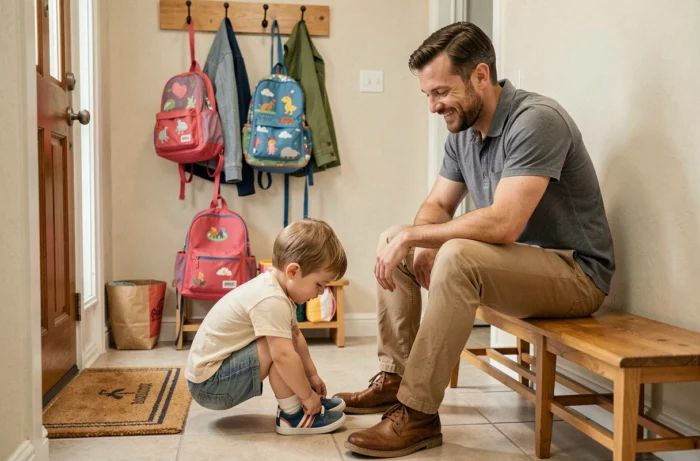
Expecting a three-year-old to sit still for forty minutes at a restaurant shows a lack of understanding of their neurological development. The prefrontal cortex, which is responsible for impulse control, only fully matures in adulthood.
Adjusting expectations does not mean tolerating everything. It means setting realistic demands for the child’s age and then gradually evolving them. A four-year-old can put away their toys in a bin; asking them to sort by category is premature.
9. Ritualize parent-child connection moments

A connection ritual does not need to be long. A few minutes of exclusive attention each day is enough: reading a story, discussing the favorite moment of the day, playing a game chosen by the child.
These rituals strengthen the attachment bond and provide an emotional safety net. A child who knows they will have their daily attention moment tolerates the frustrations of the rest of the day better.
10. Accept parental imperfection as an educational lever

Positive education does not aim for perfect parenting. Recognizing in front of your child that you were wrong (“I yelled at you, that wasn’t fair, I’m sorry”) teaches two skills: responsibility and the ability to repair a relationship.
Research in parenting shows that parent support programs yield variable results depending on the family context and the child’s level of difficulty. Beyond a certain threshold, more intensive and targeted measures become necessary, and the effects may differ between home and school.
Consistency matters more than perfection. Applying these ten tips imperfectly but consistently produces more effects than theoretically impeccable but sporadic parenting.