
The first year of a child’s life represents a significant budget for young parents. The baby registry allows for the distribution of some of these expenses among relatives, provided it is constructed methodically. Which expense categories weigh the most, and how to balance between new items, second-hand, services, and funds to create a truly useful list?
Cost of welcoming a baby: the categories that justify a baby registry
Before selecting items, it is essential to measure the actual cost of a child’s arrival. Competing guides list products without ever addressing the overall budget, which often leads to accumulating unnecessary items.
| Expense Category | Weight in First Year Budget | Relevance on a Baby Registry |
|---|---|---|
| Furniture (crib, dresser, changing table) | High | Strong (group fund or direct purchase) |
| Stroller and car seat | High | Strong (collective contribution) |
| Clothes for the first months | Moderate | Medium (rapid growth, risk of duplicates) |
| Feeding (formula, breastfeeding equipment, bottles) | Moderate to high | Low (recurring expense, very personal choice) |
| Hygiene and bath (bathtub, diapers, care) | Moderate | Medium (bathtub yes, diapers = consumable) |
| Services (cleaning, meals, photo sessions) | Variable | Strong (often forgotten, highly appreciated) |
High unit cost items (furniture, stroller, car seat) are where the collective contribution of relatives has the most impact. In contrast, consumables like formula or diapers do not lend themselves well to a registry: their cost is spread over time and preferences change after birth.
To explore the available registry formats and compare platforms, the baby registry on Le Paris des Lardons details the options available to expectant parents.
New or second-hand items on a baby registry: what the data shows
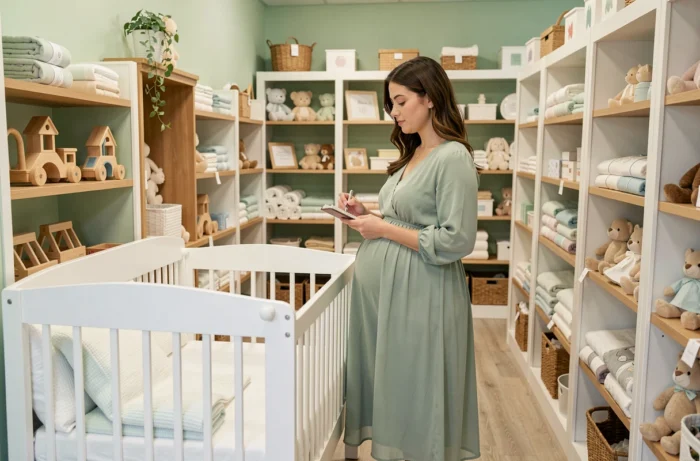
The integration of second-hand items into a baby registry is becoming increasingly common. Some platforms now allow adding links to sites like Vinted or Le Bon Coin, or explicitly stating that parents accept second-hand gifts.
This trend responds to two simultaneous realities: the rising cost of welcoming a child and a growing focus on responsible consumption. Adding second-hand items is entirely possible and increasingly common on modern registries.
Not all products are equal when it comes to second-hand. Here’s the distinction that matters:
- Suitable for second-hand: clothes (sizes 0 to 6 months worn for a few weeks), developmental toys, books, baby bouncer, baby bathtub. These products experience little wear and represent significant savings.
- To buy new for safety: car seat (unknown accident history, safety standards), crib mattress (hygiene, deformation), breast pump (parts in contact with breast milk).
- On a case-by-case basis: stroller (check the condition of the frame and harness), crib (check spacing complies with current standards).
The car seat is the only item that should never be accepted second-hand unless its origin is certain, as an invisible impact can compromise safety.
Services, experiences, and funds: the forgotten aspects of the baby registry
Traditional guides focus on childcare items. The most useful registries in 2026 also include services and experiences that significantly lighten the daily life of the first weeks.
Among the increasingly common requests: cleaning hours, meals delivered during the first month, newborn photo sessions, babywearing classes, or postpartum massage. Post-birth services reduce mental load just as much as items, and relatives appreciate giving something personal rather than yet another 3-month size onesie.
The fund represents another underutilized lever. Rather than requesting a specific item for each price range, a targeted fund (for example, “contribution to the car seat” or “first washable diapers”) provides flexibility while guiding donors.
Balance to aim for between items, services, and funds
A list composed solely of items risks frustrating relatives on tight budgets. Conversely, a 100% fund list can seem impersonal. Mixing items at different price points, concrete services, and a targeted fund allows each relative to find their place, from a twenty-euro gift to the collective funding of an expensive item.
Composition mistakes that undermine a baby registry
Three pitfalls consistently arise and explain why some registries remain partially funded.
The first: too many clothes. Babies grow quickly, relatives spontaneously give clothes even without a registry, and sizes beyond 3 months are hard to anticipate. Limiting clothes to a few targeted pieces (sleep sack, coat, booties) avoids duplicates.
The second: no low price range. If the cheapest product on the list exceeds fifty euros, some relatives will buy nothing. Planning items or services between ten and thirty euros (a pack of bibs, a developmental book, a cleaning contribution) ensures that every budget finds a suitable gift on the list.
The third: publishing the list too late. Sharing it around the sixth or seventh month of pregnancy allows relatives time to organize, especially for group gifts. Too early, the needs are not yet clear. Too late, spontaneous purchases have already been made.
A well-calibrated baby registry does not aim to cover all of the baby’s needs. It targets areas where the help of relatives has a real impact, offers various price levels, and incorporates formats that traditional guides still largely overlook. The best registry is the one that is completely emptied before the birth, not the one with the most items.