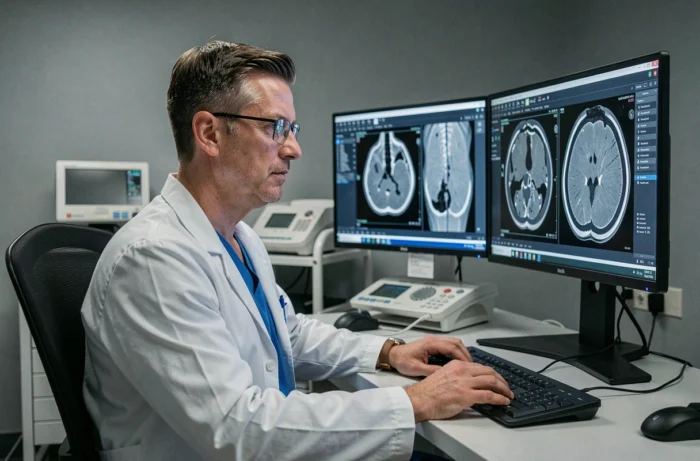
When a general practitioner in Cesson-Sévigné receives a patient after an MRI performed at a Rennes radiology office, the question is not about the diagnosis, but about access to the images. Where are they stored, how can they be viewed, and most importantly, how can we ensure they reach the right practitioner at the right time? This is precisely what the web.irld.net platform manages, a central tool in the distribution circuit of medical images in the Rennes area.
Image flow between the PACS and the practitioner: what happens after the exam
After an ultrasound, a CT scan, or an MRI, the images do not remain on the acquisition machine. They are transferred to a system called PACS (Picture Archiving and Communication System), which archives them and makes them accessible remotely.
In the network of private radiologists in the Rennes district, the common software is RIS-PACS ONE MANAGER. This system connects several dozen radiologists spread over a radius of about 40 minutes around Rennes, including city practices and clinics such as CHP Saint-Grégoire or Clinique Mutualiste La Sagesse.
The web.irld.net platform serves as the online access point to these archived images. The corresponding physician, whether a generalist or a specialist, can find their patient’s images without needing physical media. One can better understand how web.irld.net works in medical imaging when observing this concrete circuit: acquisition, PACS archiving, then availability via a secure portal.
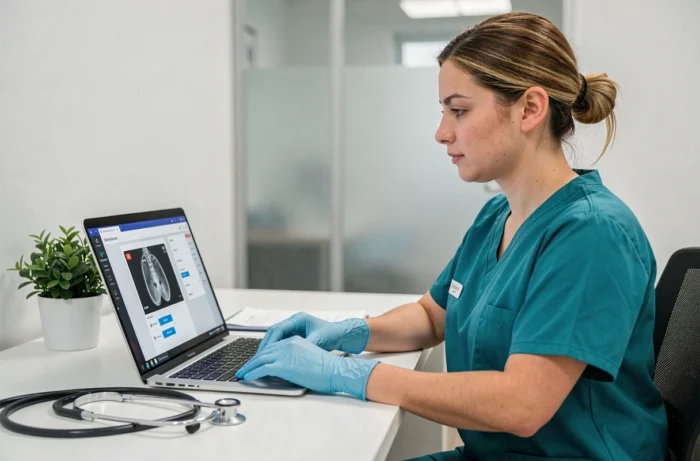
Secure access to medical imaging results via web.irld.net
The digital dissemination of radiology exam results poses a strong regulatory constraint: health data is sensitive personal data. The platform must guarantee reliable authentication before granting access to images or reports.
For the patient
The patient generally receives an identifier or a secure link after their exam, allowing them to view their results online. This mode of dissemination avoids the need to travel to the office to retrieve a CD or an envelope of images. The images remain available for several months after the exam, which facilitates follow-up during subsequent consultations.
For the prescribing physician
The practitioner who prescribed the exam accesses the images via a professional portal. The main advantage lies in speed: the results are available as soon as the radiologist has validated their report, without waiting for postal mail or a fax.
This system has been praised by physicians in the Rennes area since its implementation. Feedback varies regarding navigation fluidity depending on the internet connections of the offices, but the time savings compared to the old paper circuit is widely agreed upon.
Interoperability and Ségur du numérique: what is changing for radiology offices
The operation of web.irld.net cannot be isolated from the national regulatory context. The Ségur du numérique program in health requires health software publishers, including RIS and PACS, to comply with strengthened interoperability standards.
Since the summer of 2026, the first Ségur wave 2 referenced imaging solutions have appeared in the register of the Agence du Numérique en Santé (ANS). Among them, RIS Evolucare Imaging 9.3 and two DRIMbox (MEDIN+ ESN and Evolucare) were referenced in July 2026.
What this concretely implies for a network like that of the IRLDR:
- Images from an exam performed in Rennes can automatically feed into Mon espace santé, the patient’s digital medical record, without additional manipulation by the radiologist
- The national DRIM-M project (Data Radiologie Imagerie Médicale et Médecine Nucléaire) organizes a unique image-sharing network between establishments, via DRIMbox connected to local PACS
- Cybersecurity requirements are strengthened with each new wave of referencing, which forces platforms like web.irld.net to keep their protocols up to date
Wave 1 of the Ségur primarily laid the groundwork. Wave 2 imposes real interoperability between private practices and hospitals, which transforms the role of image distribution portals.
Practical limits and points of caution regarding the web.irld.net portal
A medical image distribution portal is not just a simple website. Its daily use reveals constraints that the official documentation does not always detail.
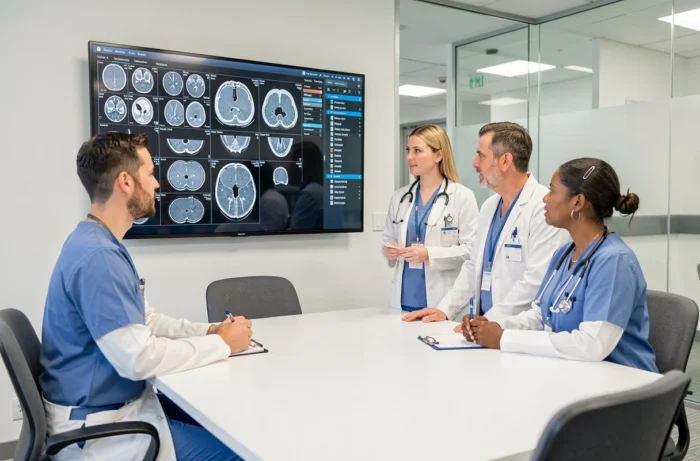
The first relates to browser and screen compatibility. A CT scan report viewed on a smartphone does not offer the same readability as an image displayed on a calibrated desktop screen. For physicians who make comparisons between successive exams, a medical-grade screen remains necessary for fine interpretation.
The second concerns the duration of image retention. While the PACS archives data long-term, access via the web portal may be time-limited. Patients are advised to download their images if long-term follow-up is anticipated, particularly in oncology or rheumatology.
The third touches on geographical coverage. The IRLDR network covers an area around Rennes that includes sites like Cesson-Sévigné, Saint-Grégoire, or CIM Laënnec. An exam performed outside this area, at a non-affiliated center, will not be accessible via web.irld.net. This is where national projects like DRIM-M make sense, aiming to connect local networks with each other.
The web.irld.net portal plays a specific role in the care chain: to make the images from a radiology exam quickly accessible, securely, to patients and practitioners in the Rennes area. With the changes imposed by Ségur wave 2 and the gradual deployment of DRIMbox, this type of local platform will need to integrate with a national network, which will likely alter access habits in the coming years.