The proportion of elderly people in the French population is steadily increasing, and the vast majority of them wish to stay at home for as long as possible. Facilitating the daily lives of seniors now involves a combination of regulatory framework, housing adaptation, and coordinated services, well beyond just connected objects.
Well-Aging Law and Early Detection: The Framework Structuring Solutions for Seniors
The “Well-Aging” law of April 8, 2024, has established a regulatory foundation that concretely modifies the organization of home care. Among the less commented measures, a sustainable mobility fund for home care aides has been created, specified by a decree on August 13, 2025, and then modified on June 12, 2026.
This fund finances the professional travel of caregivers and the time spent exchanging among themselves, a cost that had previously weighed on organizations or family caregivers.
Several texts presented in 2026 also strengthen the systems for early detection of loss of autonomy starting at age 60. The goal is to better coordinate prevention, care, and support before dependency sets in. Some specialized platforms already offer catalogs of services and equipment compliant with these developments, such as https://www.ideosenior.fr/, which lists solutions suitable for home care.
This regulatory shift reflects a change in logic: it is no longer enough to finance a single object or a one-time adaptation; the aim is to structure a continuous prevention pathway.
Inclusive Housing and Autonomous Residences: Alternatives to Traditional Home
Individual housing adaptation concentrates most of the attention, but shared housing represents another avenue. A government roadmap relayed in 2026 aims to double the shared housing stock by 2040, with funding mobilized starting this year for inclusive housing and autonomous residences.
Inclusive housing brings together several seniors in an adapted dwelling, with private spaces and common areas. A coordinator ensures social connections and daily management. This model differs from nursing homes by its lower cost and the degree of autonomy it preserves.
Autonomous Residences and Grouped Housing
Autonomous residences, managed by local authorities or associations, offer individual apartments with shared services (catering, activities, night watch). The model remains little known to the general public, even though it meets a growing demand from people who do not want to stay alone at home or enter a medical facility.
Field feedback varies on the ability of these structures to accommodate profiles at the beginning of loss of autonomy. The challenge in the coming years will be to streamline the transition between traditional home, shared housing, and medicalized structures, without disrupting the pathway.
Housing Adaptation and Financial Aid: What MaPrimeAdapt’ Changes
The MaPrimeAdapt’ scheme, operational since January 2024, unifies several existing aids to finance the adaptation of seniors’ housing. It covers concrete works:
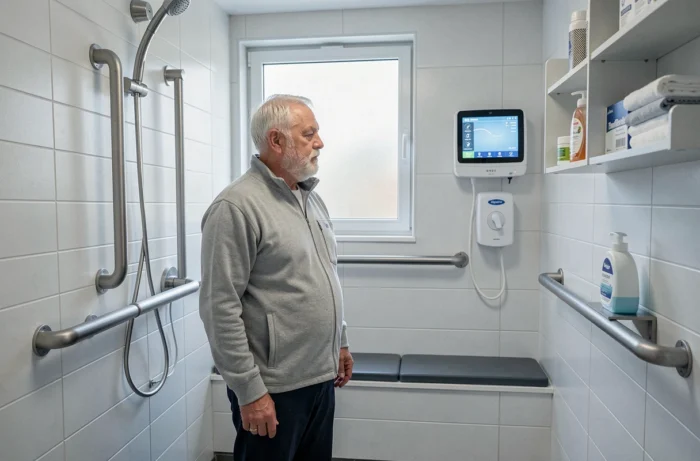
- Installation of grab bars, walk-in showers, and non-slip flooring to reduce the risk of falls in the bathroom
- Installation of stairlifts or adaptation of a living space on the ground floor for people with reduced mobility
- Improvement of lighting, widening of doors, and removal of thresholds to facilitate movement with a walker or wheelchair
The aid is subject to income ceilings and a diagnosis carried out by an approved operator. The preliminary diagnosis identifies priority works based on the level of dependency and the configuration of the housing, which avoids unnecessary or undersized adaptations.
Connected Objects and Daily Safety: What Works, What Remains Fragile
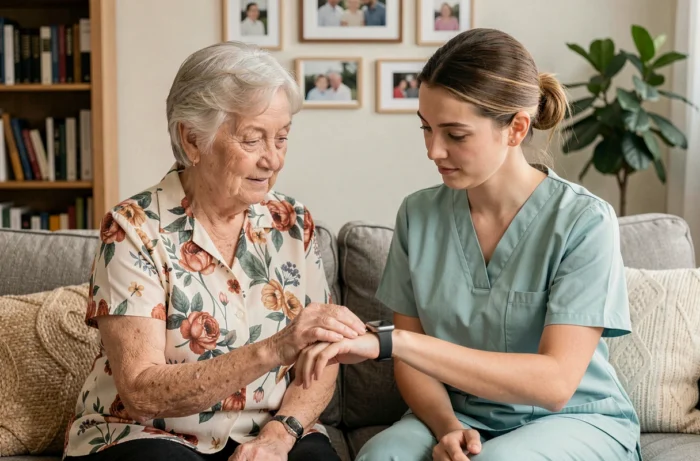
Connected watches, smart pill dispensers, fall sensors: the market for senior objects has significantly expanded. Their real utility depends on user acceptability, technical reliability, and the quality of human support.
Acceptability and Real Use
A connected object has value only if it is worn or used regularly. Fall sensors worn on the wrist, for example, still generate false positives that lead some users to remove them. Connected pill dispensers assume that the person accepts an audible or visual reminder, which is not always the case for individuals with cognitive disorders.
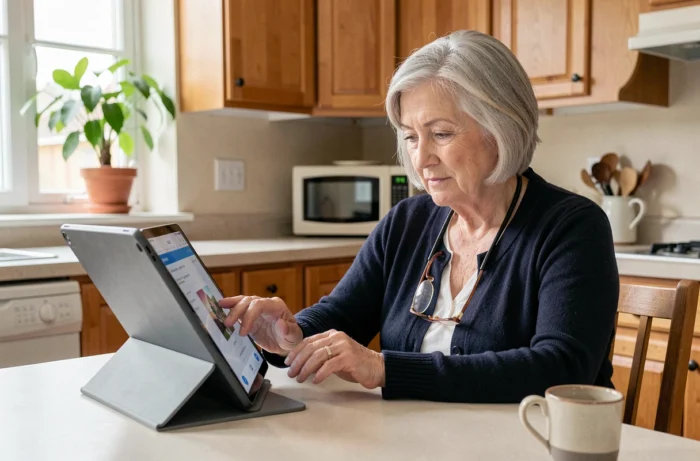
Human support remains the determining factor in the adoption of these technologies. A family caregiver or a home caregiver who configures the device, explains its operation, and checks its regular use makes the difference between a useful object and one abandoned in a drawer.
Coordination Between Objects, Caregivers, and Health Professionals
The data captured by a bracelet or motion detector only makes sense if it is transmitted to the right person at the right time. Several teleassistance platforms now integrate these flows into a dashboard shared between caregivers, nurses, and treating physicians. The available data do not yet allow for measuring the impact of these devices on reducing hospitalizations, but experiments are multiplying.
- Connected watches measure heart rate and detect falls, with an alert sent to designated contacts
- Floor sensors identify unusual movements (prolonged absence of movement, falls)
- Connected pill dispensers send a reminder to the caregiver if medication has not been taken at the scheduled time
The question of privacy remains open. Monitoring the daily life of an elderly person from a distance, even for their safety, requires informed consent and clear limits on the use of collected data.
The regulatory framework is being structured, shared housing formulas are developing, and technologies are becoming more reliable. The quality of daily support remains the guiding thread: it is the effectiveness that primarily depends on human support that determines whether these devices truly improve the lives of seniors at home.