A tenant who wants to personalize their apartment quickly hits the same wall (literally): everything related to wall coverings must be removable or restored before the exit inspection. Non-woven white wallpaper meets this requirement better than most alternatives because it combines easy installation, clean removal, and a neutral finish that suits both the tenant and the landlord.
Damage-free removal: the criterion that changes everything in rentals
Removal is rarely discussed when choosing a wall covering. In rentals, it’s the primary criterion. Traditional wallpaper glued with standard adhesive sticks to layers of paint or plaster, and tearing it off damages the substrate. The result: deductions from the security deposit, or even the recharging of an entire wall.
Further reading : Why adopting a Siamese mix cat is the ideal choice for your family
Non-woven wallpaper can be removed in whole strips, dry, without steam or spatula. You pull from a low angle, and the strip detaches from the wall in one piece. The underlying surface remains intact in the vast majority of cases, provided the wall was painted or plastered correctly before installation.
This explains the enthusiasm on social media: decorators recommend that tenants prioritize non-woven wallpaper specifically so they can remove everything at the end of the lease without leaving marks. Detailed advice on choosing wallpaper for rentals can be found on La Petite Maison dans la Prairie, which addresses this rental aspect in a concrete way.
Related reading : What is the average retirement amount for senior executives in 2023?
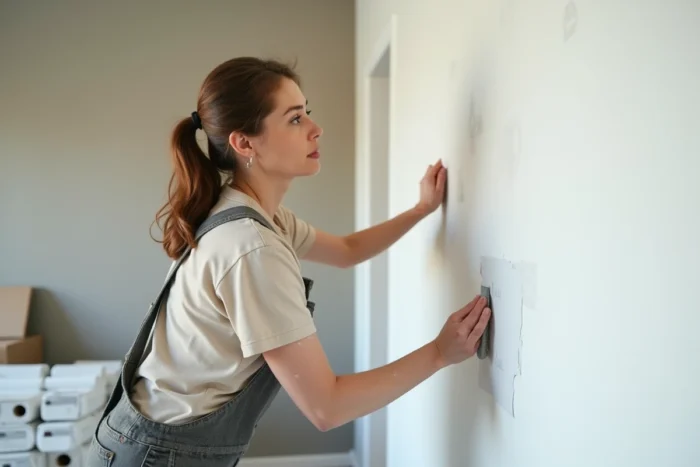
Paintable white non-woven: transform a damaged wall without heavy work
In many older rentals, walls show micro-cracks, irregularities, or traces of poorly removed previous coverings. Repairing a wall with plaster and then sanding it down is a project that neither the tenant nor the landlord wants to finance with every turnover.
Paintable white non-woven masks the defects of the substrate without filling. Major DIY retailers offer renovation coverings on non-woven, in a smooth version, with a sufficiently dense weight to cover common imperfections. You glue the wall (not the strip), apply it, smooth it out, and the result is a regular surface ready to receive paint.
For a landlord managing multiple units, this method speeds up the restoration between two tenants. Instead of calling in a plasterer, a roll of renovation non-woven and a coat of white paint are enough to make the wall clean.
What non-woven white does not correct
Feedback varies on this point, but a wall with holes from wall plugs larger than one centimeter or an active humidity problem will not be resolved by a non-woven covering. The cause must be addressed before applying anything. Non-woven hides cosmetic defects, not structural ones.
Installation by an inexperienced tenant: what makes non-woven accessible
Installing traditional wallpaper requires gluing each strip, letting it soak, and then handling it while wet. The risk of tearing or misalignment is high for someone who has never wallpapered before.
With non-woven, you glue directly to the wall, not the paper. The strip remains dry, thus rigid and easy to position. You can peel it off and reposition it in the first few minutes if the alignment is not correct. This margin for error makes all the difference when doing it alone on a Saturday morning.
- The necessary equipment consists of a glue roller, a smoothing brush, a cutter, and a spirit level, making for a minimal investment.
- A standard strip of non-woven covers a sufficient width to limit the number of seams on a wall, reducing visible errors.
- The adhesive for non-woven dries more slowly than a standard vinyl adhesive, allowing time to adjust each strip before it is permanently fixed.
Repositionable adhesive non-woven: the tenant-friendly variant without glue
Several manufacturers have developed ranges of non-woven with a self-adhesive side that completely replaces wall glue. You peel off a protective film, apply the strip to the wall, and reposition it as many times as necessary. Removal is done by pulling the strip without leaving any adhesive residue.
This type of product explicitly targets tenants. On TikTok and Instagram, feedback shows that the adhesion is good on smooth, painted walls, but textured or porous surfaces sometimes pose problems. Before applying adhesive non-woven, test it on a hidden corner of the wall to check adhesion and cleanliness upon removal.
Solid white or subtle pattern: what choice for a rental
Solid white remains the safest choice for a rental. It does not displease anyone during a visit, it matches all furniture, and it reflects light in dark rooms. A tenant who wants to personalize further can paint over the white non-woven with a shade of their choice, then repaint white before leaving.
A subtle pattern (fine stripes, slightly embossed texture) also works, but it is more committing. If the pattern does not appeal to the next tenant or the landlord, it will need to be removed entirely. White, on the other hand, transitions from one lease to another without question.
Comparison of non-woven white wallpaper, paint, and vinyl wallpaper in rentals
| Criterion | Non-woven white | Paint only | Vinyl wallpaper |
|---|---|---|---|
| Installation by a non-professional | Accessible (gluing wall) | Accessible | Difficult (gluing strip) |
| Removal at the end of the lease | Whole strip, dry | Not applicable | Often in pieces |
| Masks wall defects | Yes (micro-cracks, irregularities) | No | Partially |
| Compatible with humid rooms | Yes (washable) | Yes (suitable paint) | Yes |
| Risk of deposit retention | Low if removal is clean | Low | Medium to high |
Non-woven white combines the advantages of paint and wallpaper without the major drawbacks of each in a rental context. Paint alone does not mask anything, and vinyl is difficult to remove. Non-woven offers a compromise that the other two options do not allow.
The last point to keep in mind: check the condition of the wall before applying, choose an adhesive suitable for non-woven (not a universal adhesive), and always keep a half-strip in reserve for potential repairs during the lease. This stock prevents the need to find the same reference months later when the manufacturer may have removed it from the catalog.