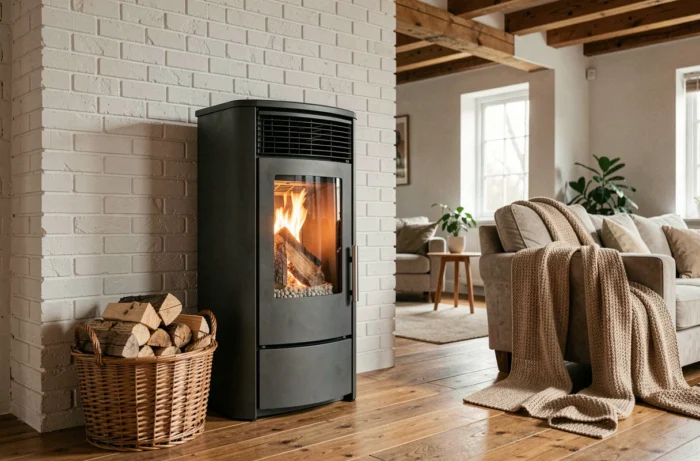
A wood pellet, or pellet, is a cylinder of compressed sawdust about six millimeters in diameter, whose high energy density allows for almost complete combustion. This fuel powers both stoves and boilers. The French production sector has undergone a profound restructuring since the pricing crisis of 2022-2023. Understanding how this heating system works, its real constraints, and the criteria for choosing a device helps determine if this solution is suitable for a given home.
Combustion of pellets and efficiency: what happens in the device
The combustion of a wood pellet is based on a simple principle: a screw conveyor transports the pellets from a hopper to a combustion chamber. A fan injects the necessary air, and ignition is achieved by an electric resistance. This automation distinguishes pellet heating from log heating, where the supply remains manual.
The efficiency of a pellet stove typically reaches 87 to 90 %, compared to 50 to 70 % for an open log fireplace. This figure reflects the portion of energy from the fuel that is effectively converted into useful heat. The Flamme Verte label guarantees a minimum efficiency of 87 % and a low level of greenhouse gas emissions.
The electronic regulation continuously adjusts the pellet feed rate and air flow. A room thermostat can control the device to maintain a set temperature in the main room. This fine management reduces consumption compared to traditional wood heating, where the power mainly depends on the amount of logs loaded.
To delve into the technical specifics and possible configurations, your pellet heating deserves an analysis tailored to the area and insulation of the concerned home.
Pellet market in 2025-2026: prices and stability of the sector
The price surge of 2022-2023 left a mark and slowed down some equipment projects. The French sector has since increased its production capacities, which has eliminated the imbalance between supply and demand. According to data relayed by Propellet, the pellet market is now described as more predictable and stable, even though prices remain slightly higher than before the crisis.
Records published by Selectra over the last three seasons show that seasonal variations remain contained. In 2025-2026, the bulk ton price rises from about 368 euros in September to a winter peak around 380 euros, representing an increase of about 3.3 %. This low seasonal amplitude means that buying at the end of summer rather than in mid-winter only represents a modest saving per ton.
Comparing the cost per kilowatt-hour with other energies
Wood pellets remain among the cheapest fuels when compared to the kilowatt-hour produced. Their price fluctuates less dramatically than that of heating oil or natural gas, whose prices depend on international markets. This relative price independence is a significant argument, provided there is sufficient storage space to order in bulk.
Installation and storage constraints for pellets
A pellet stove requires a flue that complies with current standards, a fresh air intake, and a nearby electrical outlet. Installation by a qualified RGE (Recognized Environmental Guarantee) professional is a prerequisite for accessing financial assistance.
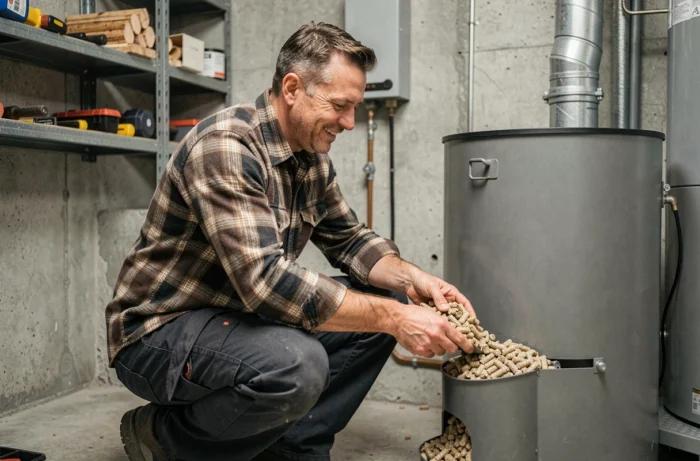
The issue of pellet storage often determines the type of device chosen. A stove has an integrated hopper of several dozen kilograms, manually reloaded every two to three days during cold periods. A pellet boiler requires a dedicated silo, installed in an adjacent room or outside, capable of holding several tons to cover an entire season.
- A pellet stove is suitable for moderately sized homes where it serves as the main heating source in the living area, with supplementary heating in other rooms.
- A pellet boiler supplies a circuit of radiators or underfloor heating and can cover the entire home, including the production of domestic hot water.
- A pellet insert fits into an existing chimney and allows for the utilization of an already installed flue, with significantly higher efficiency than an open fireplace.

Maintenance of pellet heating: frequency and obligations
Regular maintenance is essential for the efficiency and lifespan of the device. The combustion chamber and ash pan must be cleaned at least once a week during use. Ash residues, which are very low due to the nearly complete combustion of the pellets, can still accumulate and obstruct air circulation if cleaning is neglected.
Chimney sweeping is mandatory, usually twice a year, including once during the heating season. An annual complete maintenance by a qualified technician checks the tightness of the circuit, the proper functioning of the screw conveyor, and the condition of the seals. This visit represents a recurring cost to be included in the overall budget.
Noise and daily comfort
The operation of a pellet stove generates two sources of noise: the screw conveyor that transports the pellets and the convection fan. In recent models, the noise level has been reduced, but it remains noticeable in a quiet room, especially at night. Some devices offer a silent mode that turns off the fan at the cost of slower heat distribution through natural convection.
Financial assistance for the installation of a pellet stove or boiler
The MaPrimeRénov’ scheme remains the main financial lever to reduce the purchase and installation cost. The amount depends on the household’s income and the type of device. The installation must be carried out by an RGE professional to qualify for this assistance.
Other mechanisms can be combined: energy savings certificates, zero-interest eco-loans, local assistance depending on the community. The combination of these schemes can cover a significant portion of the initial investment, which remains higher than that of an electric convector but amortizes over time due to the moderate cost of the fuel.
Pellet heating combines high efficiency, a fuel sector that has stabilized, and automation that brings it closer to the comfort of a gas boiler. The two points to decide before committing remain the available space for storage and tolerance for the mechanical noise of the device, two constraints that only a technical visit to the home can accurately assess.