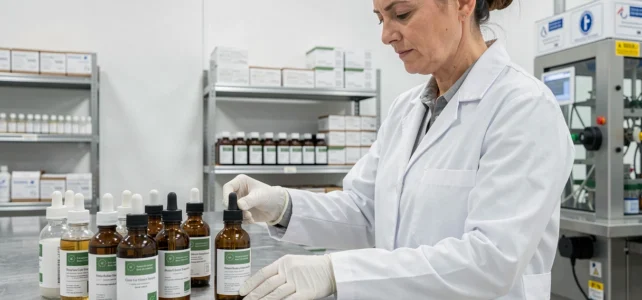
When a tube of cream or a lipstick displays the Avril logo, we know it is certified organic. What is less known is where it was formulated, by whom, and why the manufacturing location varies from one product to another. The brand, founded in Roubaix, does not own its own factories. It entrusts production to partner laboratories located in France, Italy, or Spain, depending on the product category.
Avril Manufacturing: A Model Without Own Factory
Avril operates on a simple principle: the brand designs the formulas, selects the ingredients, and defines the specifications, then delegates production to specialized contractors. This model, common in cosmetics, allows collaboration with laboratories that master each type of texture or formulation.
Recommended read : How to Energize Your Visual Communication with Creative and Innovative Solutions
A contractor specialized in anhydrous formulas (without water, like lipsticks) does not have the same equipment as a laboratory specialized in emulsions (creams, lotions). Entrusting each range to the right partner ensures a more reliable technical result than if a single factory produced everything.
To deepen the traceability of each range, the source of Avril products on Makeup Chic details the supply chains by product category.
Further reading : How to Choose the Right Size M for Men: Size Guide and Measurements
Avril Production Locations: France, Italy, and Spain Depending on Ranges
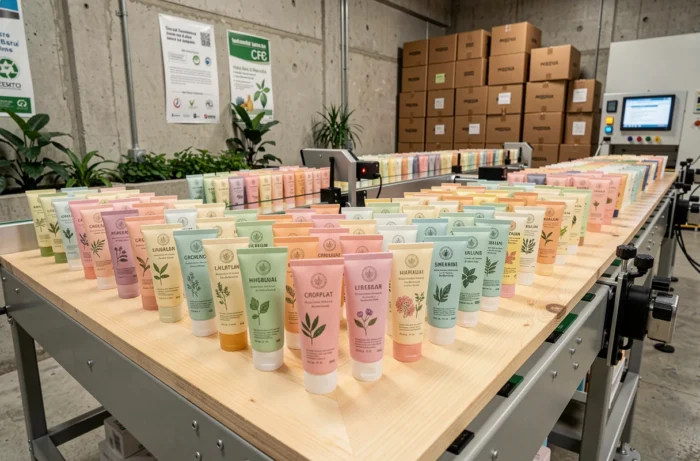
The mention “made in France, Italy, or Spain” often appears in the general descriptions of the brand. This formulation remains vague. In reality, the country of manufacture depends on the type of product.
Face Care and Pro Age+ Range Made in France
The specifications of several recent references (Pro Age+ face serum, Pro Age+ night cream, face oils) mention a manufacturing location in France. The identified contractor for these products is Microcosme SAS, based in Bondues, in the North, just a few kilometers from Avril’s headquarters in Roubaix.
This choice of proximity reduces the distance between the formulation office and the production laboratory. The back-and-forth to adjust a texture or validate a batch is quicker. For an anti-aging range that requires concentrated active ingredients and precise stability tests, this short link between design and manufacturing has a direct impact on the quality of the finished product.
Makeup: Historically Produced in Italy
Italy, and more specifically the Lombardy region, concentrates a large part of the world’s expertise in makeup. Foundations, mascaras, powders: many European brands have their colored products manufactured there. Avril is no exception.
Composition analyses published by specialized blogs confirm that references like the black volume mascara or foundation are produced in Italy. Italian contractors have production lines suited to pigments, waxes, and compact textures.
One point deserves attention: some recent makeup references now carry the mention “made in France”. This is the case for Cosmos Organic certified eyebrow fixing pencils. The brand thus seems to be gradually bringing part of its makeup production back.
Body Hygiene and Spain
Shower gels and some body care products are manufactured in Spain. The country has competitive contractors for large volumes of hygiene products, where the formulas are simpler (cleansing base, fragrance, moisturizing actives) and production rates are high.
Avril Organic Certification and Quality Control in Outsourced Production
Entrusting manufacturing to multiple countries raises a legitimate question: how to guarantee the organic level at each site? The answer lies in the Ecocert and Cosmos Organic certifications, which apply to the finished product regardless of the production location.
Specifically, the Cosmos Organic specifications impose:
- A minimum percentage of natural origin ingredients, verified on each batch by the certifying body
- The prohibition of certain processing methods deemed polluting or denaturing (for example, certain hydrogenations)
- The traceability of raw materials, from the ingredient supplier to the packaged product
Each partner contractor must be audited to obtain and maintain its ability to produce under the Cosmos Organic label. It is not Avril that decides alone that the product is organic: a third-party organization validates each reference.
Avril Accessories: An Acknowledged Asian Manufacturing
Avril’s brushes, sponges, and makeup accessories do not follow the same circuit. They are manufactured in Asia. This choice reflects an industrial reality: the production of cosmetic accessories is concentrated in Asia, where the supply chains for synthetic hairs and handles are structured on a large scale.
The brand communicates little on this point, which can create a gap with the general discourse on European manufacturing. Distinguishing cosmetics (formulas) from accessories (tools) helps to understand why the two circuits coexist.
Low Prices and Avril Manufacturing: What Explains the Economic Model
Avril offers prices significantly lower than the organic market average. This positioning relies on several levers that have nothing to do with the quality of the formulas:
- Minimalist packaging, without excessive packaging or luxurious packaging
- Very low advertising expenses compared to competing brands
- Deliberately compressed margins, made possible by high sales volumes
- The use of specialized contractors by product type, which optimizes production costs
Low prices do not mean cheap manufacturing. The certifications impose a verifiable quality baseline. The choice to eliminate the superfluous (marketing, packaging) rather than cutting back on the formula explains the price gap with other organic brands.
The recent trend of bringing some manufacturing back to France, notably through the partnership with Microcosme SAS in Bondues, shows a desire to shorten the supply chains for higher value-added ranges. For high-volume hygiene products, the industrial logic remains European but not exclusively French. This geographical distribution, far from being a flaw, reflects a technical trade-off between contractor expertise and cost control.