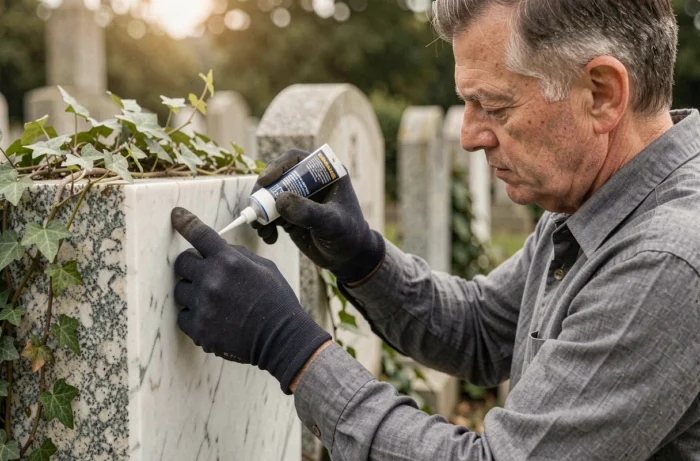
Fixing a memorial plaque to granite, marble, or reconstituted stone involves constraints that most online guides treat as a simple choice of tube in a store. The material of the support, that of the plaque, the local climate, and even the cemetery regulations condition the type of adhesive, surface preparation, and durability of the bond.
This article compares the main families of adhesives used for this fixation and details the parameters that make the difference between a hold of a few months and one of several years.
EN 12004 Standard and Adhesive Class: What Construction Teaches Funerary Practices
Contents dedicated to memorial plaques rarely cite the technical texts that frame glued installation on natural stone outdoors. The EN 12004 standard classifies adhesive mortars according to their performance. For outdoor use subjected to freeze-thaw cycles and hygrometric variations, the C2S1 or C2S2 classes (improved, deformable adhesive) are recommended by the NF DTU 52.2, which deals with ceramic coverings and similar materials, including natural stones.
This classification is not anecdotal. A deformable adhesive absorbs the micro-movements related to the thermal expansion of granite or marble. A rigid adhesive, even initially strong, will eventually crack due to seasonal temperature fluctuations. Therefore, the choice of an appropriate adhesive for gravestones first involves reading the performance class on the packaging, even before considering the brand.
This normative framework allows for quick sorting of products sold in large DIY stores, where mentions of “multi-purpose” or “outdoor” do not guarantee the necessary deformability.
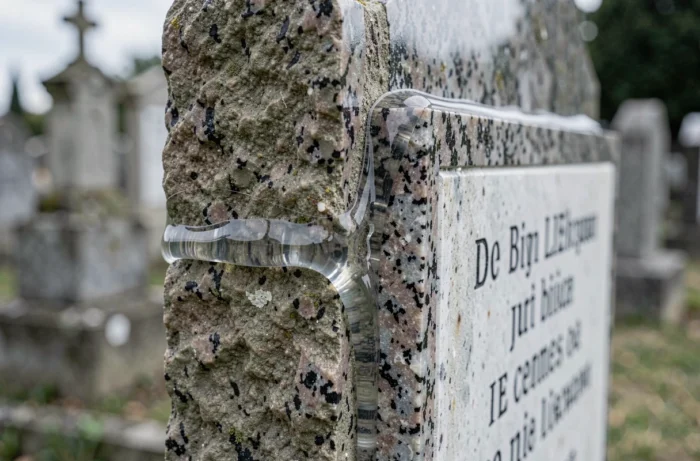
Comparison of Adhesives for Memorial Plaque Fixation
Four families of adhesives are commonly used. Their properties diverge on key criteria for durable outdoor fixation.
| Type of Adhesive | Weather Resistance | UV Resistance | Flexibility After Drying | Suitable for Natural Stone |
|---|---|---|---|---|
| Two-component Epoxy | Very High | Medium (yellowing possible) | Rigid | Yes (granite, polished marble) |
| Polyurethane Adhesive Sealant | High | Variable depending on formulation | Flexible | Yes |
| Neutral Silicone Adhesive Sealant | High | Good | Very Flexible | Yes, if neutral silicone |
| C2S1/C2S2 Adhesive Mortar | Very High | Not applicable (joint not exposed) | Deformable | Yes (DTU reference) |
Epoxy adhesive offers one of the strongest mechanical bonds, but its rigidity makes it vulnerable to thermal stresses over large surfaces. In contrast, polyurethane sealant or neutral silicone tolerate micro-movements better.
Acetic silicone (the most common in large stores) should be excluded: its acetic acid attacks marble and certain limestone stones. Only neutral curing silicone is suitable for natural stone.
Quick Reading of the Table
For a small ceramic, bronze, or resin plaque, epoxy or neutral silicone is sufficient. For a heavier granite plaque, the deformable adhesive mortar of class C2S1 remains the most compliant solution with building practices.
Cemetery Municipal Regulations: A Constraint Before Choosing Adhesive
Each municipality establishes a cemetery regulation that may impose restrictions on fixation methods. Some prohibit drilling the stele, while others require a mechanical fixation for elements exceeding a certain projection. These rules vary from one municipality to another and are not mentioned on any adhesive packaging.
In practical terms, if the regulation prohibits drilling, gluing becomes the only option, but the choice of adhesive must then ensure sufficient hold without mechanical reinforcement. Conversely, if the regulation mandates screws or plugs for plaques over a certain weight, adhesive alone is not sufficient, regardless of its performance level.
Checking the cemetery regulations before purchasing a product avoids the need to remove and reattach a plaque under more restrictive conditions. This document can be consulted at the town hall or with the cemetery caretaker.
Surface Preparation and Installation Conditions on Gravestones
The quality of the bond depends as much on the preparation as on the product itself. Three parameters condition adhesion on a mineral surface outdoors.
- The cleanliness of the support: residues of moss, lichen, or pollution form an intermediate layer that prevents the adhesive from gripping the stone. Cleaning with clear water and a nylon brush, followed by complete drying, is the minimum requirement. Aggressive solvents may stain polished granite.
- Degreasing both surfaces: the back of the plaque and the bonding area on the stele must be free of greasy marks. A wipe with isopropyl alcohol is sufficient on most materials.
- Installation temperature: most adhesives require an ambient temperature between 5 and 35 °C to polymerize correctly. Bonding in freezing weather or in full summer sun compromises curing and thus long-term hold.
The holding time after application varies according to the adhesive family. Epoxy reaches initial set in a few hours, while neutral silicone often requires longer for complete polymerization. During this phase, the plaque must remain stationary: a wide masking tape or a temporary support device prevents any slipping.
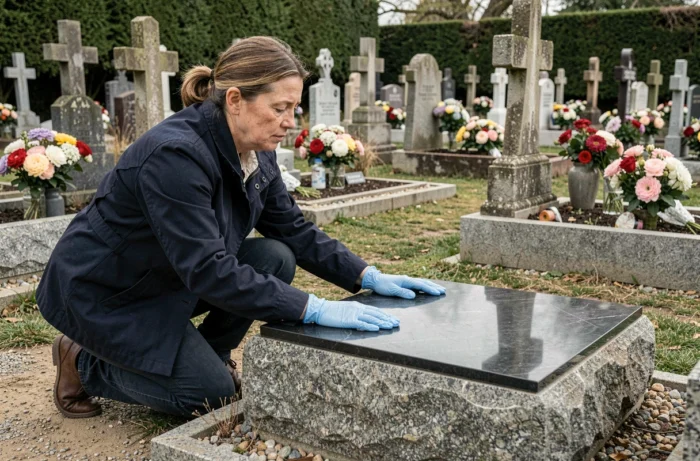
Common Mistake: Applying Too Much Adhesive
An excess of product does not strengthen the bond. On the contrary, a joint that is too thick takes longer to polymerize deeply and may remain soft in the center, weakening the whole. A regular bead of a few millimeters thick spread over the entire contact surface produces a more reliable result than a central lump.
Durability and Maintenance of an Outdoor Bonded Fixation
A properly bonded plaque with an adhesive suitable for the support and local climatic conditions lasts several years without intervention. Loss of adhesion most often occurs due to insufficient surface preparation or an inappropriate choice of adhesive for the material.
To prolong the fixation, an annual visual inspection allows for early detection of any lifting before it worsens. If an edge lifts, partial re-bonding with the same type of adhesive is possible after cleaning the old adhesive.
The key takeaway is: the deformability class of the adhesive weighs more than its raw pull strength in an outdoor context subjected to thermal variations. This parameter, more than the brand or price, determines whether the plaque will remain in place season after season.