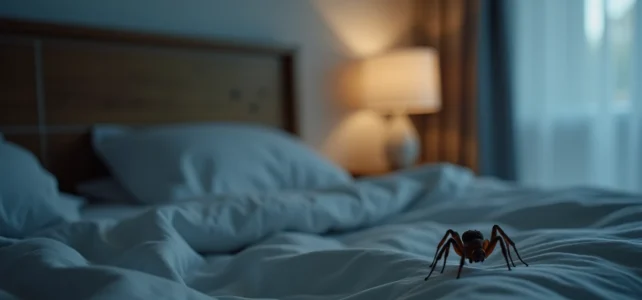
The light is turned on at two in the morning, and a spider scuttles along the wall next to the pillow. The classic reflex is to jump out of bed, grab a shoe, or flee the room. This reaction is normal, but it amplifies the rise in stress instead of calming it. Learning to manage this precise moment allows for quicker return to sleep and, gradually, to reduce the fear of spiders in the home.
The first 30 seconds facing a spider at night: an anti-panic protocol
The problem is not the spider. The problem is the adrenaline rush that accompanies the surprise. One goes from deep sleep to a state of maximum alertness in a fraction of a second, and the brain interprets the situation as a life-threatening danger.
Related reading : Everything you need to know about the address and access to the P2 parking at Stade de France
To short-circuit this spiral, one can treat the nighttime encounter as a micro-exercise in anxiety management. The idea is not to become friends with the spider, but to regain control of one’s breathing before any physical action.
Specifically, one inhales through the nose for four seconds, holds for two seconds, then exhales slowly through the mouth for six seconds. Three cycles are enough to lower the heart rate. During this time, the spider usually does not move; it is just as surprised as we are.
Read also : Where to Park for Free in Arcachon: All the Tips to Save on Parking
Once the breath is stabilized, we requalify what we see. It is not a predator; it is a few-gram animal looking for insects. In metropolitan France, the spiders found in homes do not pose a serious health risk. This factual reminder, repeated at each occurrence, eventually modifies the automatic reaction.
There are also detailed tips on what to do when facing a spider in the bedroom according to common species in France.
Capture and relocate a spider without killing it: the glass-cardboard technique
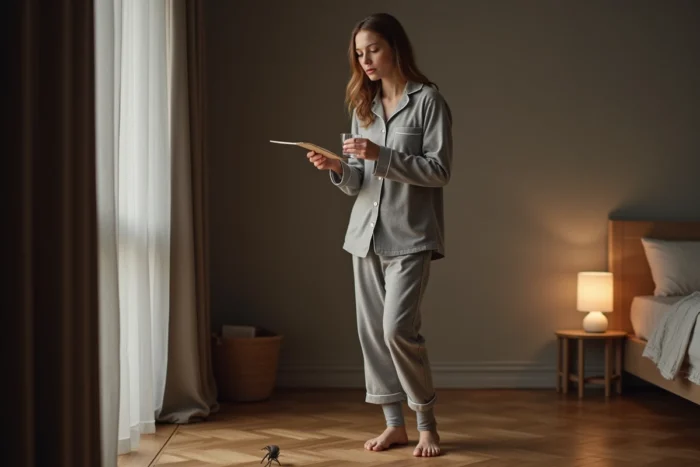
Squashing the spider seems like the quick solution, but one loses a helper that naturally regulates the insect population in the house (mosquitoes, gnats, moths). The gentle method remains capturing it with a transparent glass and rigid cardboard.
Here is the sequence, step by step:
- Slowly approach a transparent glass (not opaque, to maintain visual contact) and place it over the spider against the wall or ceiling.
- Slide a piece of cardboard between the glass and the surface, making sure not to trap the spider’s legs.
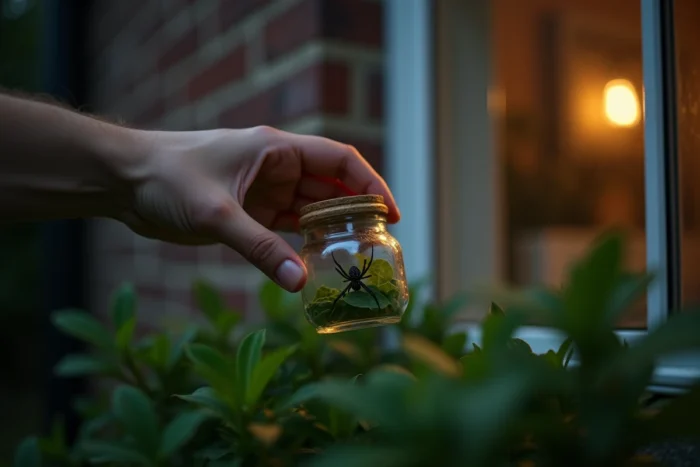
- Flip the whole thing over and move the spider to another room or outside, a few meters from the bedroom window.
The transparent glass has a specific advantage: one can see the spider inside, which reassures that it is contained. The constant visual contact decreases the feeling of loss of control.
For those who cannot stand proximity, a long-neck cup or a container with a handle (like a measuring cup) adds a few centimeters of distance. Feedback varies on this point; some people prefer an opaque cup precisely so they do not see the spider.
Preparing the bedroom in advance: the seasonal anti-spider kit
Spiders enter homes more frequently in the fall, a breeding season when males seek females. Rather than reacting urgently to each nighttime intrusion, one can prepare the bedroom in advance with a few simple gestures.
Natural repellents that work in the bedroom
Peppermint and lavender are the two most documented repellents. A few drops of peppermint oil diluted in water, sprayed on window frames and baseboards, create an olfactory barrier. Cedar wood placed in dark corners (under the bed, behind the nightstand) complements the setup.
Reducing what attracts spiders to the room
A spider does not come into a bedroom by chance. It follows its food source: small insects attracted by light and moisture. Two concrete actions limit this presence:
- Regularly vacuum under the bed and behind furniture to eliminate emerging webs and eggs.
- Install a mosquito net or proper window seals, especially if the bedroom opens onto a garden or vegetated area.
- Turn off outside lights near the bedroom windows in the evening, as they attract the insects that spiders feed on.
Removing the food source is more effective than any repellent. A well-vacuumed, uncluttered, and properly ventilated bedroom attracts very few spiders.
Arachnophobia and nighttime reaction: when fear exceeds mere discomfort
There is a difference between jumping at the sight of a spider and being unable to return to the bedroom for hours. Arachnophobia affects a significant portion of the population and triggers intense physical reactions: tachycardia, trembling, nausea, and sometimes panic attacks.
If the presence of a spider at night causes anxiety that regularly prevents sleep, cognitive-behavioral therapy (CBT) yields concrete results. The principle is based on gradual exposure: one starts by looking at photos, then videos, then observing a spider from a distance, and so on.
This approach transforms exactly the type of situation described above, the unexpected nighttime encounter, into a gradual desensitization exercise. Sessions with a therapist help frame the stages and prevent exposure from becoming counterproductive.
For mild to moderate phobias, simply repeating the breathing-observation-capture sequence at each encounter with a spider in the house creates a natural habituation mechanism. One does not eliminate the fear, but reduces its intensity and duration over the weeks.
A spider in the bedroom at night is neither a hygiene problem nor a sign of infestation. It is a temporary visitor, often solitary, that disappears on its own within a few days if not provided with food. Keeping a glass and cardboard on the nightstand remains the simplest defense, applicable even when half asleep.