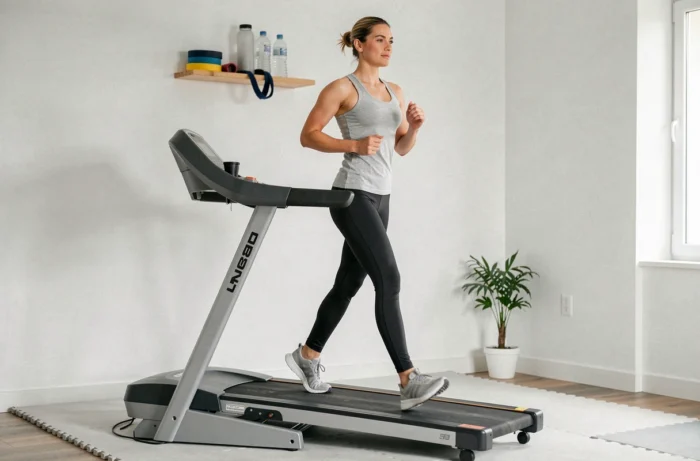
The first selection filter for a home treadmill is neither the motor power nor the maximum speed. It is the usage class according to ISO 20957, an indicator that most product sheets relegate to the bottom of the page. This class determines the weekly usage duration validated by the manufacturer: HC for three hours, HB for five hours, SB for fifteen hours, SC for thirty hours. Buying an HC model for four sessions a week means operating the device outside specifications, with direct consequences on the longevity of the motor and the belt.
ISO 20957 Usage Class and Machine Regulation 2023/1230: What Changes for the Treadmill
We recommend always starting with the usage class before examining any other feature. A regular runner (three to four sessions per week of forty-five minutes) is already in class SB. An occasional walker working from home remains in HC or HB.
The European regulation 2023/1230 on machines will come into effect soon. Every new treadmill must comply with this framework for design, conformity assessment, technical documentation, CE marking, and safety instructions. Manufacturers that do not comply with these requirements will see their products removed from the European market.
For buyers, this means that models currently in stock do not necessarily meet these future obligations. We are already observing adjustments from several brands regarding emergency stop systems and the documentation provided. Comparing the technical sheets available on https://www.tapis-course.net/ allows you to verify compliance and detailed specifications before purchase.
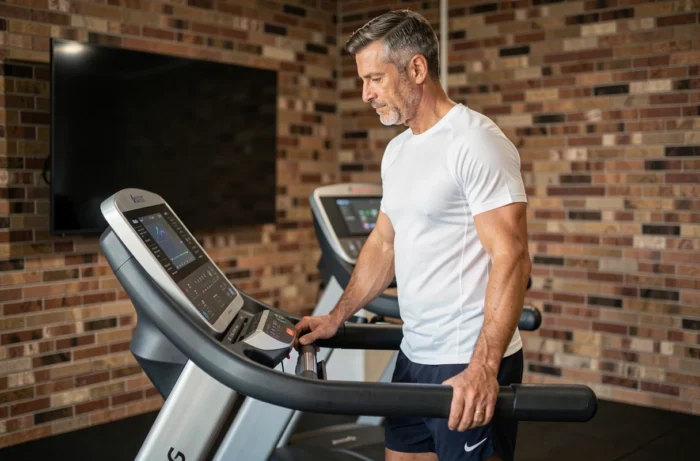
Running Surface and Cushioning: The Two Parameters That Determine Stride
The running surface is measured in length and width of the belt. To run without the risk of overshooting, the belt must exceed the runner’s natural stride. A minimum of 40 cm wide and 120 cm long is required for running. Below this, only walking remains comfortable.
An above-average build or a long stride requires a longer belt, ideally over 130 cm. This is a point that comparisons often gloss over by providing generic ranges.
Cushioning: Soft Does Not Mean Effective
The cushioning of the deck absorbs joint impacts, but a system that is too soft degrades energy return and distorts running sensations. Runners preparing for road competitions prefer firm cushioning, closer to asphalt. Profiles in rehabilitation or overweight benefit more from adjustable cushioning.
Adjustable cushioning in multiple zones of the deck remains the best compromise. Some manufacturers offer interchangeable elastomers under the platform, allowing for hardness adjustments based on usage without changing devices.
Motor Power and Maximum Speed of the Treadmill: Reading Beyond Marketing
The continuous motor power (duty rating) and peak power do not describe the same reality. Only continuous power determines the motor’s ability to sustain prolonged effort. A motor with high peak power but low continuous power will overheat during long sessions at sustained pace.
The maximum speed must correspond to your actual profile. A regular jogger at a moderate pace does not need a treadmill that exceeds 16 km/h. In contrast, a runner doing high-intensity interval training needs sufficient margin for their fast intervals.
- For brisk walking and working from home under a desk: a low continuous power motor is sufficient, with a speed capped between 6 and 8 km/h
- For regular endurance running: prioritize a motor with comfortable continuous power and a maximum speed of at least 16 km/h
- For interval training and competition preparation: a motor with high continuous power and a speed above 18 km/h, with a quick response time to pace changes
Incline and Training Programs: Simulating Real Terrain
Motorized incline transforms a basic treadmill into a physical training tool. It allows for the reproduction of elevation profiles, works the muscular power of the lower limbs, and increases energy expenditure without accelerating.
Models with a negative incline (descent) add an eccentric work axis rarely available on entry-level devices. This type of solicitation is particularly useful in trail preparation.
Integrated Programs or Third-Party Applications
Pre-recorded programs generally cover fundamental endurance, short intervals, and weight loss. Their interest quickly diminishes for an experienced runner. Compatibility with third-party applications (via Bluetooth or ANT+) offers more flexibility to manage structured sessions from a personalized training plan.
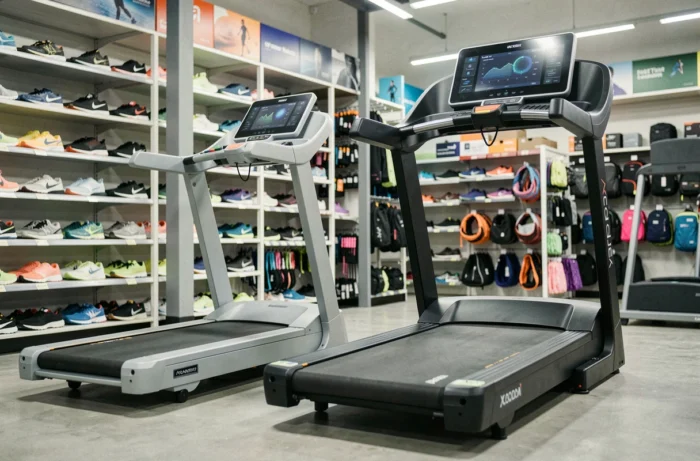
Folding Treadmill and Footprint: A Weight-Stability Trade-off
The folding format addresses a real space constraint in apartments. The compromise lies between saving space and stability while running. A lightweight folding treadmill vibrates more at high speeds than a heavier fixed model.
The maximum user weight indicated on the technical sheet should be taken with a margin of at least 20% above the actual weight of the runner. This margin protects the chassis, the belt, and the motor over time.
- Check the locking system in the folded position (child safety, storage stability)
- Compare the weight of the device when unfolded: a treadmill that is too light lacks inertia and slides on certain floors
- Check the height when folded to ensure it fits under a piece of furniture or in a closet
The trend since 2024 shows a shift towards compact treadmills designed for brisk walking or under-desk use, with reduced maximum speeds and ultra-thin formats. This segment does not replace a true treadmill for structured cardio training, but it meets a different need, that of integrating physical activity into the workday.
The final choice rests on the coherence between the usage class, the belt surface, the continuous power of the motor, and the format. A device well-sized for your actual practice will last longer and provide better sensations than a model overqualified in maximum speed but underqualified in structure.