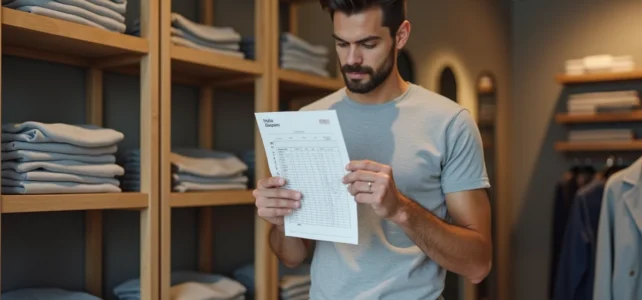
Size M for men theoretically corresponds to a French 48-50, but this equivalence varies depending on brands, cuts, and types of clothing. Two M sizes purchased from different stores can differ by several centimeters in the chest or waist. Taking body measurements remains the only reliable way to choose the right size.
Why Size M is Not the Same Everywhere
The letter sizing system (S, M, L, XL) does not follow any universal standard. Each brand defines its own measurement ranges for the same letter. For men’s tops, size M can correspond to a chest measurement of 94 to 104 cm according to the consulted charts.
Recommended read : How to Choose the Perfect A-Line Dress for a Wedding When You're Curvy?
At Kiabi, the men’s M covers French sizes 38/40 with a chest measurement of 96 to 102 cm. At Destock Jeans, M corresponds to a chest measurement of 89 to 95 cm, which is a French size 40. The gap between these two size charts reaches several centimeters on the same body part.
This disparity comes from cut choices. A brand that offers fitted cuts will calibrate its M tighter than a brand focused on loose cuts. Consulting the size M correspondences for men allows for comparison of these ranges before purchasing.
Read also : How to Choose the Right Telescopic Hedge Trimmer for a Perfect Garden

Body Measurements: Chest, Waist, and Hips
Three measurement areas determine a man’s clothing size. Chest, waist, and hips form the reference trio used by most brand guides.
How to Take These Three Measurements
- The chest measurement is taken at the widest part of the torso, under the arms, with the tape measure held horizontally and not too tight. This is the primary measurement for choosing a top (t-shirt, sweater, jacket).
- The waist measurement is taken at the natural dip, between the ribs and the pelvis, while exhaling normally. This reference is mainly used for pants and jeans.
- The hip measurement is taken at the fullest part of the hips, with feet together. This measurement is more significant for bottoms than for tops.
The measuring tape should remain parallel to the ground. A tilted or too tight tape can distort the result by several centimeters. Measuring over a thin t-shirt gives a more realistic result than on bare skin, as the garment will be worn over at least one layer of fabric.
Which Measurement Takes Precedence Depending on the Garment
For a top, the chest is the decisive measurement. When the chest and waist measurements yield two different sizes, Nike recommends relying on the chest. For pants, it is the hips and waist that dictate the choice.
This principle avoids a common pitfall: choosing a top in M because the waist measurement fits, while the chest measurement requires an L. The garment will be too tight at the shoulders and chest.
Standard Size M and Tall Size M: Two Distinct Fits
One aspect that classic guides rarely address: the letter M says nothing about the length of the garment. A man who is 1.85 m and a man who is 1.72 m can have the same chest measurement, but their needs for torso and sleeve length differ significantly.
Some brands now offer “Tall” variants for each letter size. A Tall M adds several centimeters in torso and sleeve length compared to the standard M, without changing the width. The inseam receives the same treatment for pants.
Measuring sleeve length (from the top of the shoulder to the wrist) and inseam (from the groin to the floor, barefoot) completes the chest-waist-hips trio. These measurements help distinguish a need for standard M from a need for Tall M, or to identify that an S Tall would fit better than a standard M.

Unsure Between Two Sizes: Logic Changes Depending on Use
Finding oneself between an S and an M (or between an M and an L) is the most common situation. The answer depends on the desired effect.
- For a fitted cut (body-hugging t-shirt, tailored shirt), choosing the smaller size gives a sharper fit.
- For a loose fit or layering garment (sweatshirt, jacket), the larger size allows for comfort and movement.
- For a technical or sports garment, the smaller size limits excess fabric, but the larger size allows for layering over a thermal undergarment.
The desired fit influences the choice as much as the measured centimeters. The same man can wear a fitted M in a t-shirt and an L in a jacket without any changes in his measurements.
Some product sheets specify whether the fit is “regular,” “slim,” or “relaxed.” This indication, combined with the brand’s size chart, significantly reduces the risk of error. Without this mention, doubt remains, and the larger size is the safest choice to avoid a return.
Size M for men remains a starting point, not a guarantee of fit. A measuring tape, three correctly taken measurements, and consulting the brand-specific chart transform a generic letter into a reliable choice.