
The decoration budget is the one that generates the most discrepancy between couples’ expectations and the final bill. Reference items continue to show ranges of 1,500 to 3,000 euros, but feedback from providers on recent weddings paints a different reality, with budgets rising significantly as soon as a complete scenography comes into play.
Wedding decoration budget: the gap between online figures and reality
Most guides provide an estimate that places decoration between 10 and 15% of the overall budget, or about 1,500 to 3,000 euros for a standard wedding with around a hundred guests. This framework remains valid for a simple decoration, with basic elements placed on tables and a few floral arrangements.
Related reading : How to Choose the Right Telescopic Hedge Trimmer for a Perfect Garden
Projects accompanied by decorators or wedding designers tell a different story. In Normandy, a professional in the field indicates that decoration budgets now hover around 5,000 euros, with a common range of 3,000 to 10,000 euros when adding flowers, lighting, furniture, table art, stationery, and guest gifts.
A couple considering immersive decoration based on a “classic blog” budget hits a wall as soon as they receive the first quotes, as detailed by the site Mariage et Mariages in its analysis of actual costs.
Further reading : How to Choose the Perfect A-Line Dress for a Wedding When You're Curvy?
This distortion is explained by the proliferation of scenographic inspirations on social media. Couples arrive with very developed mood boards, but without an awareness of the cost of each element displayed in these images.
Flowers and season: the item that can triple the bill
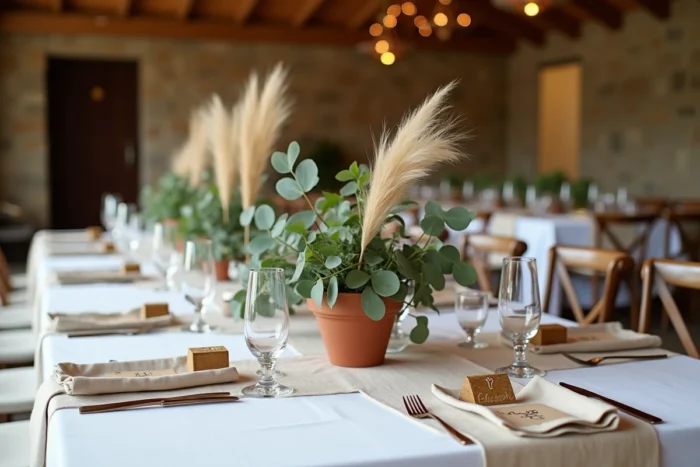
Flowers represent the most unpredictable variable in the decoration budget. Two weddings with the same number of tables can show a considerable gap depending on the chosen season and the requested varieties.
A wedding in June or July benefits from a wide floral offering, with peonies, garden roses, and delphiniums available locally. A wedding in December or January relies on imported flowers, often two to three times more expensive for the same volume. The choice of season weighs as heavily as the choice of florist on the final line.
- Dense table arrangements (tall centerpieces, greenery garlands running the length) consume much more plant material than a trio of single-stem vases per table, for a sometimes comparable effect in photos.
- The bride’s bouquet, the ceremony arch, and the boutonnieres form a block often underestimated that can represent several hundred euros on their own.
- Reusing arrangements between the ceremony and the reception (moving altar arrangements to the dining area) allows for a reduction in the volume of flowers ordered without compromising the overall look.
Asking the florist for a proposal using local seasonal flowers before finalizing a mood board is the most effective approach to manage this item.
Furniture rental and scenography: the invisible item in online budgets
Classic budget guides rarely list furniture rental as a distinct item. However, it has become common, especially when the reception venue does not provide chairs, tablecloths, or dishware suitable for the desired style.
Renting cross-back chairs, linen tablecloths, chandeliers, or metal arches transforms the ambiance of a raw venue. The unit cost of each piece seems modest, but multiplying by the number of tables quickly increases the bill. For 80 guests, just the rental of decorative chairs, tablecloths, and structural centerpieces can reach an amount comparable to that of the flowers.
The choice of reception venue has a direct impact on this item. A domain already furnished and tastefully decorated reduces the need for additions. A bare reception hall, rented at a moderate rate, can end up costing as much once dressed. The decision is not based solely on the price of the hall but on the total cost of the hall plus decoration.
Lighting: the technical item that changes everything
Lighting is often addressed at the end of the budget, after flowers and furniture. However, string lights, a starry sky, or a sufficient number of candles change the atmosphere of a room more than an elaborate centerpiece.
Investing a few hundred euros in lighting often has more visual impact than an equivalent supplement on floral arrangements. This is a lever that professional decorators systematically use, but that couples managing on their own often overlook.
Distributing the decoration budget: concrete trade-offs before quotes
Before contacting a florist or decorator, establishing three parameters changes the course of planning.
- Identify whether the venue provides furniture and dishware, and in what condition. A domain that offers white tablecloths and folding chairs covers the minimum functional requirements, but not necessarily the desired aesthetics.
- Set the number of “zones” to decorate: bride and groom’s table, guest tables, ceremony, cocktail hour, photobooth. Each added zone multiplies the decorative element needs.
- Decide early what is non-negotiable (for example, a flower arch) and what can be simplified (for example, candles only on the tables instead of floral arrangements).
Field feedback varies on the value of entrusting everything to a single provider versus coordinating several suppliers independently. An event decorator charges for their coordination service but often negotiates better rates with their usual suppliers. The net gain depends on the volume of decoration and the number of providers involved.
DIY remains a viable option for targeted elements (stationery, small gifts, signage), as long as the time required for production is not underestimated. Several weeks of preparation for a few hundred euros in savings: the trade-off is personal, not universal.
The decoration budget for a wedding is better managed by starting from the venue and the season than by applying a theoretical percentage to the overall budget. The discrepancies between the ranges published online and actual quotes continue to surprise couples who begin their search for providers.